SSRM GTC
SSRM GTC develops cognitive alignment technologies designed to strengthen emotional stability and decision clarity under pressure while preserving user privacy.
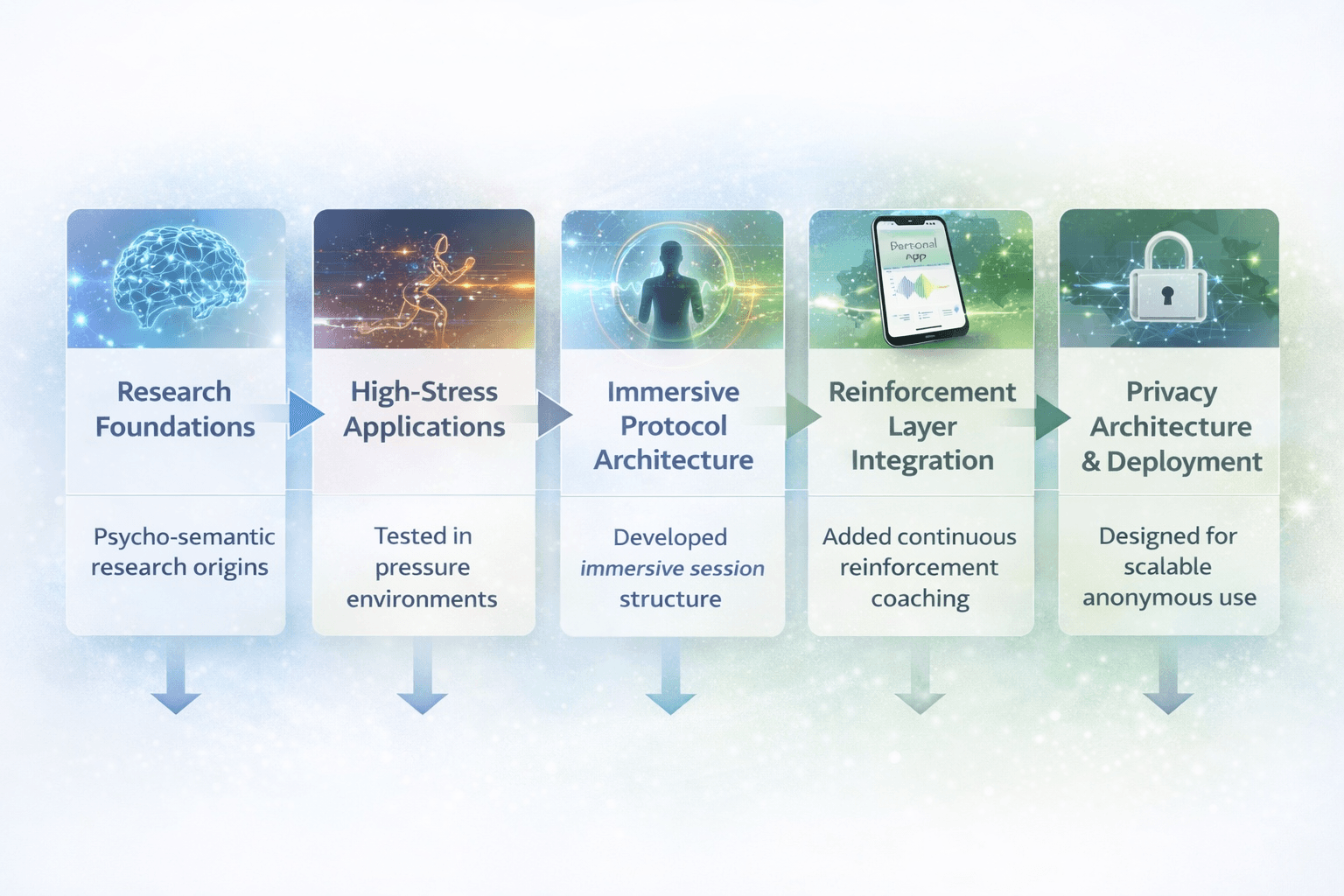
The Five Phases of Development
01
Phase I — Research Foundations
Origins in psycho-semantic research examining how subconscious response structures influence emotional stability, perception, and decision-making under pressure.
Early work focused on methods for measuring emotional constructs and verifying changes through repeatable frameworks.
01
Phase I — Research Foundations
Origins in psycho-semantic research examining how subconscious response structures influence emotional stability, perception, and decision-making under pressure.
Early work focused on methods for measuring emotional constructs and verifying changes through repeatable frameworks.
02
Phase II — High-Stress Application Environments
The research frameworks were applied in environments characterized by elevated psychological pressure, where emotional instability could affect operational outcomes.
These applications helped identify which subconscious constructs destabilize behavior and how structured modulation could restore stability.
02
Phase II — High-Stress Application Environments
The research frameworks were applied in environments characterized by elevated psychological pressure, where emotional instability could affect operational outcomes.
These applications helped identify which subconscious constructs destabilize behavior and how structured modulation could restore stability.
03
Phase III — Immersive Protocol Architecture
Research methods were translated into structured immersive session formats capable of guiding construct modulation in a controlled and repeatable way.
This phase established the core protocol architecture that would later become SSRM Tech™.
03
Phase III — Immersive Protocol Architecture
Research methods were translated into structured immersive session formats capable of guiding construct modulation in a controlled and repeatable way.
This phase established the core protocol architecture that would later become SSRM Tech™.
04
Phase IV — Reinforcement Layer Integration
To sustain stability beyond immersive sessions, a reinforcement system was introduced.
Early work focused on methods for measuring emotional constructs and verifying changes through repeatable frameworks.
a structured immersive protocol guiding construct alignment
a continuous reinforcement layer supporting stability between sessions
04
Phase IV — Reinforcement Layer Integration
To sustain stability beyond immersive sessions, a reinforcement system was introduced.
Early work focused on methods for measuring emotional constructs and verifying changes through repeatable frameworks.
a structured immersive protocol guiding construct alignment
a continuous reinforcement layer supporting stability between sessions
05
Phase V — Privacy Architecture & Institutional Deployment
To support large-scale deployment, the system was designed with a privacy-first architecture.
Access is provided through anonymous tokens, separating user identity from system interaction and enabling responsible deployment across individuals and organizations.
05
Phase V — Privacy Architecture & Institutional Deployment
To support large-scale deployment, the system was designed with a privacy-first architecture.
Access is provided through anonymous tokens, separating user identity from system interaction and enabling responsible deployment across individuals and organizations.
Foundational Methodology
The methodology informing SSRM Tech™ was developed by Dr. Semyon Ioffe through professional research in psycho-semantic response measurement and structured subconscious modulation.
The methodology informing SSRM Tech™ was developed by Dr. Semyon Ioffe through professional research in psycho-semantic response measurement and structured subconscious modulation.
This research established the conceptual framework underlying the SSRM alignment system.
This research established the conceptual framework underlying the SSRM alignment system.